
your feed knows something you don't
for centuries, understanding yourself required introspection. today, your algorithm might get there first.

Your profile is the story you’re telling. Your feed is the story you didn’t know you were telling.
One is authored. The other is observed.
We spend an absurd amount of time curating our public identities. Instagram profiles become mood boards. LinkedIn becomes professional fan fiction. Spotify Wrapped gets posted as if listening to Blood Orange is somehow a personality trait instead of... just listening to Blood Orange. Every platform asks us, in one way or another, to answer the same question: Who are you?
We answer with photos we almost posted, bios we rewrote seventeen times, playlists with names like “late night thoughts” that somehow contain exactly the same songs as everyone else’s “late night thoughts.” We build coherent versions of ourselves because humans like coherence. We like believing we’re the kind of person who reads more than they scroll, cooks more than they order, and watches documentaries instead of compilations titled Kendall Roy once said.
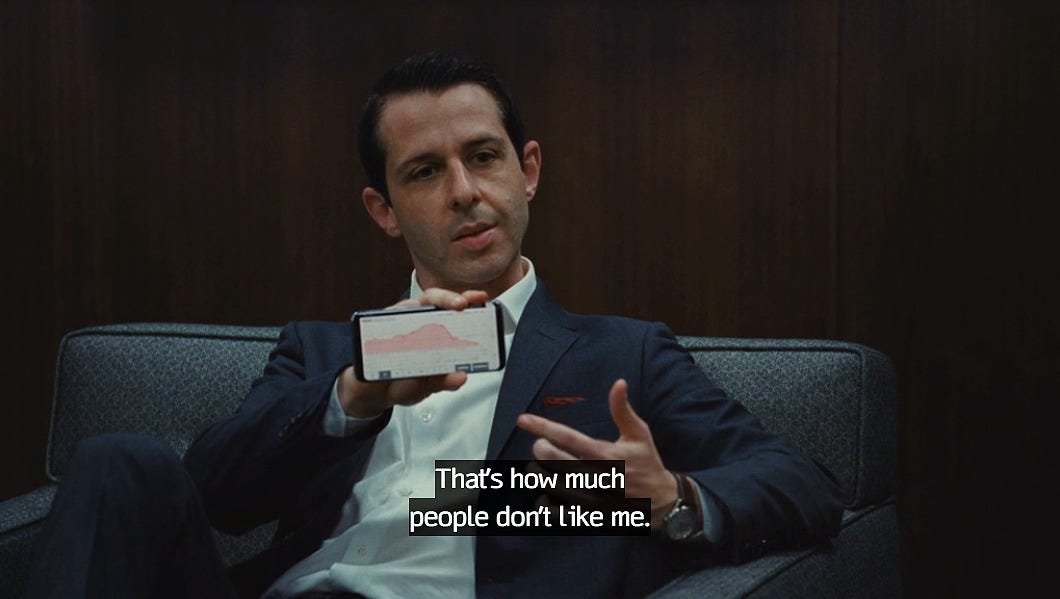
Our profiles aren’t lies. They’re just edited. Your For You page, on the other hand, has absolutely no interest in your narrative. It doesn’t care who you think you are. It cares what you do.
Nobody consciously decides to build an identity out of apartment tours in Tokyo, war history TikToks, one woman’s oddly specific pasta recipes, Formula 1 edits, clips of Love Island, relationship psychology, and urban planning videos narrated by a guy with suspiciously good lighting. Yet somehow, those things end up living together on the same feed, as if someone emptied your subconscious onto a table and arranged it according to engagement rate.
That’s because recommendation systems don’t learn from what you declare. They learn from what you can’t help but reveal.
Every pause.
Every rewatch.
Every video you almost skipped but didn’t.
Every rabbit hole that somehow started with “how to make better coffee” and ended two hours later with the geopolitical implications of shipping containers. Don’t pretend you haven’t done it. Mine once started with one New York apartment tour and ended with a thirty-minute explanation of zoning laws. I watched the whole thing. I still don’t know how I got there.
The algorithm isn’t interviewing you. It’s conducting surveillance in the most boring sense of the word: watching.
After enough observation, something strange begins to happen. The feed starts surfacing interests you haven’t consciously admitted to yourself yet. A city you’ve never considered visiting suddenly appears every other day. A career you’ve never seriously entertained becomes strangely compelling. A sport you used to ignore quietly becomes part of your weekly routine because, apparently, you’re now emotionally invested in a twenty-two-year-old Norwegian chess player. You don’t remember deciding to care. You just... do.
That’s the part people find unsettling.
Not that the algorithm is collecting data. We’ve collectively accepted that somewhere between accepting cookies and giving apps permission to track us “while using the app.” That conversation is over. What’s unsettling is that it often feels right.
Painfully right.
It has an uncanny ability to identify patterns before we have language for them ourselves. Sometimes it feels less like personalization and more like being psychoanalyzed by a product manager in California.
Which made me wonder whether we’ve been describing recommendation systems completely backwards.
Maybe they aren’t recommendation engines. Maybe they’re behavioural mirrors.
For centuries, understanding people depended on asking them questions. Psychologists conducted interviews. Anthropologists lived alongside communities. Marketers ran focus groups. Pollsters designed increasingly elaborate surveys. Different disciplines, same basic assumption: if we ask carefully enough, people can explain themselves.
Recommendation systems quietly abandoned that assumption.
They don’t ask. They watch. That difference sounds trivial until you realize it’s one of the biggest methodological shifts in the history of understanding human behaviour.
An interview gives you a story. Observation gives you a pattern. Stories are valuable. Patterns are predictive.
Imagine asking someone what music they listen to. You’ll probably hear something like, “Honestly, a bit of everything.” Which, translated into plain English, means absolutely nothing.
Ask Spotify the same question, however, and you’ll get a surprisingly detailed psychological profile disguised as listening habits. It knows that every Sunday evening your music becomes slower. It knows you replay sad songs but rarely save them. It knows your workout playlist gradually gets heavier after twenty minutes. It knows you skip jazz after thirty seconds but somehow sat through an eighteen-minute ambient track because the algorithm correctly guessed you were trying to fall asleep.
One answer is autobiography. The other is behaviour. Behaviour has a habit of being brutally honest.
And that’s where Freud unexpectedly walks back into the conversation—not because he could have predicted TikTok, although I like to imagine he’d have had a field day with it—but because he built an entire theory around a simple idea: the version of ourselves we consciously narrate and the version actually driving our behaviour are not always the same person.
The question, a century later, isn’t whether he was right.
It’s whether we’ve accidentally built the first technology capable of watching that second person at scale.
The reason Freud still feels strangely relevant isn’t because he predicted social media. He obviously didn’t. It’s because he spent his career arguing that there is always a gap between the person we believe ourselves to be and the person revealed through our behaviour.
Dreams mattered because they escaped conscious control. Slips of the tongue mattered because they bypassed intention. Jokes, compulsions, irrational fears—they all interested Freud for the same reason: they were moments where the unconscious briefly interrupted the carefully managed version of ourselves.
The unconscious wasn’t something you could interview. If you asked someone why they had a particular dream, Freud would probably tell you they were the least qualified person to answer. The unconscious had to be inferred from patterns. You couldn’t observe it directly, only through the traces it left behind.
Swap dreams for scrolling, and the sentence becomes surprisingly contemporary.
Your feed isn’t interested in what you think about yourself. It is interested in the tiny behavioural leaks that happen when nobody is watching—or rather, when nobody except the algorithm is watching.
Every extra second you linger on a video. Every time you reopen the app five minutes after swearing you were done. Every creator you don’t follow but somehow know by name. Every late-night search that felt random until it wasn’t.
Individually, these actions mean almost nothing. Together, they form one of the richest behavioural datasets ever assembled about a human being.
What’s remarkable isn’t that companies collect this information. It’s that they learned something psychology has been trying to prove for decades: observation is often more reliable than explanation.
Behavioural economists have spent years showing that humans are terrible witnesses to their own decision-making. Ask people why they bought a particular product, and they’ll usually give you an answer. It might even sound convincing. The problem is that convincing isn’t the same thing as correct. Much of our cognition happens automatically, outside conscious awareness, long before our inner narrator arrives to explain what “really” happened.
Psychologists Richard Nisbett and Timothy Wilson made this argument almost fifty years ago in a paper with the wonderfully passive-aggressive title Telling More Than We Can Know. Their conclusion was uncomfortable then and remains uncomfortable today: people routinely invent explanations for mental processes they cannot actually access. We’re remarkably good at producing coherent stories. We’re much less reliable at identifying the causes of our own behaviour.
Recommendation systems quietly took that insight and built a trillion-dollar industry around it.
Instead of asking who you are, they ask a much more useful question: What are you most likely to do next?
That sounds like a small distinction. I don’t think it is.
For most of modern history, understanding someone meant reconstructing their past. Recommendation systems care almost exclusively about your future. Every model, every prediction, every recommendation is ultimately trying to answer the same question: given everything we’ve observed so far, what is this person most likely to pay attention to next?
Not what they liked yesterday. Not who they say they are today. What they’ll want tomorrow.
That’s a fundamentally different way of understanding people.
In fact, I’d argue recommendation systems aren’t really personalization engines at all. They’re prediction engines masquerading as personalization. We think TikTok is trying to show us videos we’ll enjoy.
It’s actually trying to predict which version of our future self is most likely to stay for another thirty seconds. That shift—from describing people to predicting them—is one of the biggest methodological changes we’ve seen in decades.
And prediction, almost inevitably, becomes influence. Because here’s the part we don’t talk about enough. Algorithms don’t simply discover our interests. They reinforce them.
Imagine the algorithm notices that you’ve lingered on a few videos about moving abroad. Nothing dramatic. You paused a little longer than average. Maybe you watched an apartment tour in Copenhagen. Maybe you saved a video about life in Tokyo. Maybe you searched “cost of living in Lisbon” once after a particularly bad Monday at work.
The algorithm notices.
The next day, there are five more videos.
Then creators documenting their lives overseas.
Then salary comparisons.
Then visa advice.
Then “things I wish I knew before leaving.”
Six months later, you’re telling your friends you’ve always dreamed of living abroad.
Have you?
Or did a passing curiosity slowly become an ambition because the system kept feeding it back to you?
It’s almost impossible to separate discovery from reinforcement. That’s why I don’t love describing algorithms as mirrors.
Mirrors are passive.
Recommendation systems aren’t.
They’re closer to personal trainers.
Sometimes they’re encouraging good habits.
Sometimes they’re enabling terrible ones.
But they’re always applying resistance in one direction or another.
Every recommendation is a tiny nudge. Every nudge slightly increases the probability of another. Every interaction trains the model, and the improved model changes what you’ll encounter tomorrow.
It’s a feedback loop disguised as entertainment. And the strangest part is that it feels completely voluntary. Because nobody is forcing you to watch the next video. The system just gets increasingly good at making the next choice feel like it was yours all along.
Further reading
Psychoanalysis & Psychology
Freud, S. (1953). The Interpretation of Dreams (J. Strachey, Trans.). Hogarth Press. (Original work published 1900).
Govrin, A. (2025). Beyond the Black Box: Why Algorithms Cannot Replace the Unconscious or the Psychodynamic Therapist. Frontiers in Psychiatry, 16, Article 1614125. https://doi.org/10.3389/fpsyt.2025.1614125
Knafo, D. (2024). Artificial Intelligence on the Couch: Staying Human Post-AI. American Journal of Psychoanalysis, 84(2), 155–180. https://doi.org/10.1057/s11231-024-09423-8
Nisbett, R. E., & Wilson, T. D. (1977). Telling More Than We Can Know: Verbal Reports on Mental Processes. Psychological Review, 84(3), 231–259.
Turkle, S. (1988). Artificial Intelligence and Psychoanalysis: A New Alliance. Daedalus, 117(1), 241–268.
Behavioral Science
Kahneman, D. (2011). Thinking, Fast and Slow. Farrar, Straus and Giroux.
Thaler, R. H., & Sunstein, C. R. (2008). Nudge: Improving Decisions About Health, Wealth, and Happiness. Yale University Press.
Simon, H. A. (1971). Designing Organizations for an Information-Rich World. In Computers, Communications, and the Public Interest. Johns Hopkins University Press.
Algorithms & Technology
Pariser, E. (2011). The Filter Bubble: What the Internet Is Hiding from You. Penguin Press.
Possati, L. M. (2021). The Algorithmic Unconscious: How Psychoanalysis Helps in Understanding AI. Routledge.
Ricci, F., Rokach, L., & Shapira, B. (Eds.). (2022). Recommender Systems Handbook (3rd ed.). Springer.
Sutton, R. S., & Barto, A. G. (2018). Reinforcement Learning: An Introduction (2nd ed.). MIT Press.
Media & Culture
Han, B.-C. (2022). Infocracy: Digitalization and the Crisis of Democracy. Polity.
McLuhan, M. (1964). Understanding Media: The Extensions of Man. McGraw-Hill.
Postman, N. (1985). Amusing Ourselves to Death. Viking.
Zuboff, S. (2019). The Age of Surveillance Capitalism. PublicAffairs.